
Exness Leverage Trading in Qatar
Access flexible leverage ratios with Exness in Qatar. Trade forex and CFDs with leverage up to 1:2000, dynamic adjustments, and risk management tools.
 Related trading guides:
- Exness Margin Explained
- CFD Risk Management Guide
- Exness Trading Strategy Guide
- Advanced Forex Trading Strategy
- Open a Free Exness Demo Account
How leverage works on Exness accounts
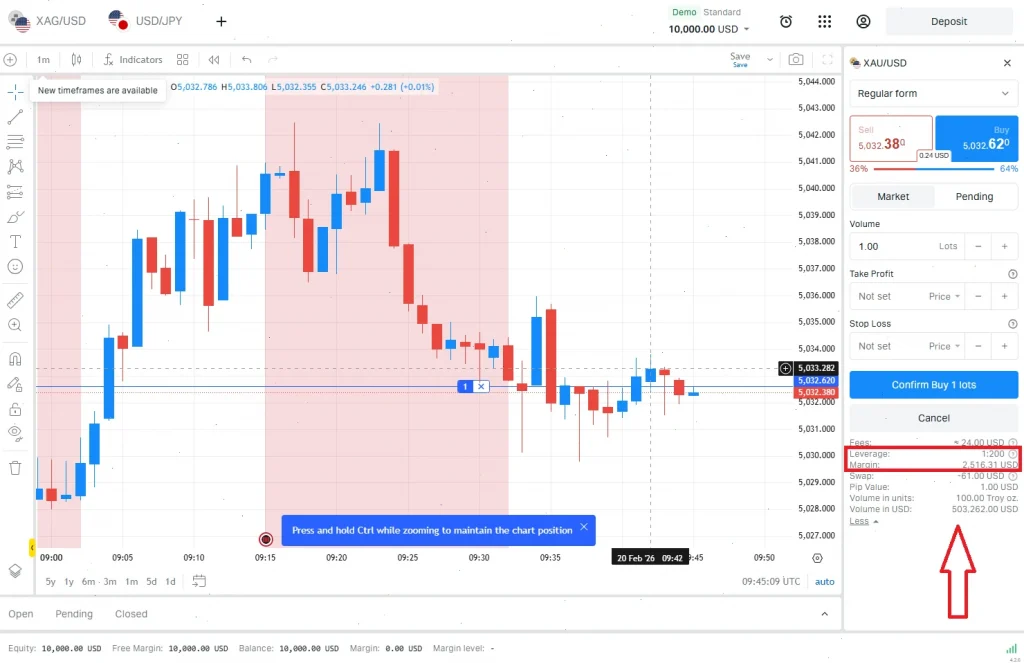
Leverage on Exness isn’t fixed in a single number—it shifts depending on your account balance and what’s happening in the market. In Qatar, traders can technically access ratios from 1:2 up to 1:2000, but in practice the available level often changes as equity grows or volatility increases.
For example, with a smaller account balance, higher leverage is usually available, which allows opening larger positions with less capital. As equity increases, leverage may gradually decrease. This isn’t random—it’s part of the broker’s internal risk controls to prevent overexposure during unstable market conditions.
Margin is calculated using a standard formula:
Required Margin = (Contract Size × Price) ÷ Leverage
In real trading, this means that a higher leverage ratio reduces the margin needed to open a trade—but also increases sensitivity to price movements. Even small fluctuations can significantly affect account equity when leverage is high.
| Account Type | Max Leverage | Minimum Deposit | Margin Call |
|---|---|---|---|
| Standard | Up to 1:2000 | $10 | 60% |
| Standard Cent | Up to 1:2000 | $10 | 60% |
| Pro | Up to 1:200 | $200 | 30% |
| Zero | Up to 1:2000 | $500 | 50% |
| Raw Spread | Up to 1:2000 | $200 | 50% |
Changing leverage settings: what actually happens
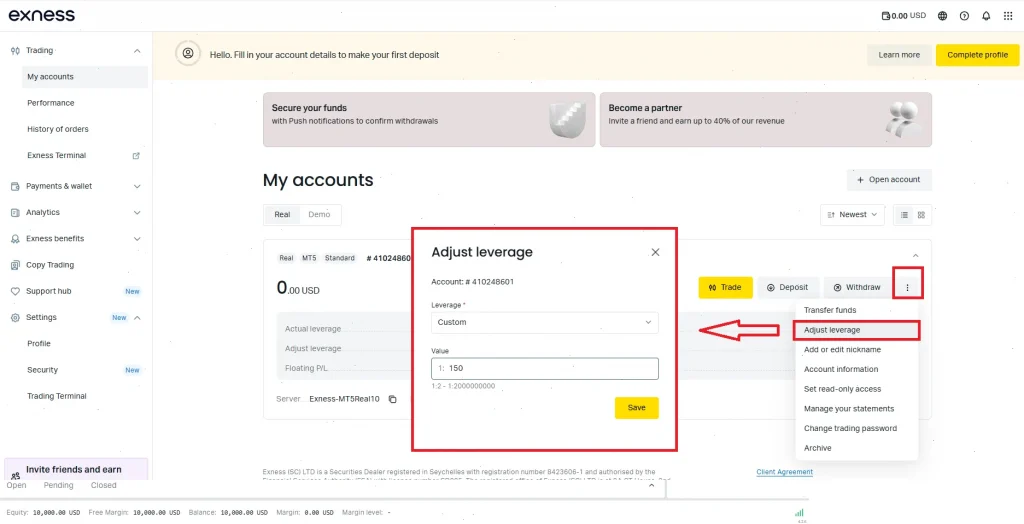
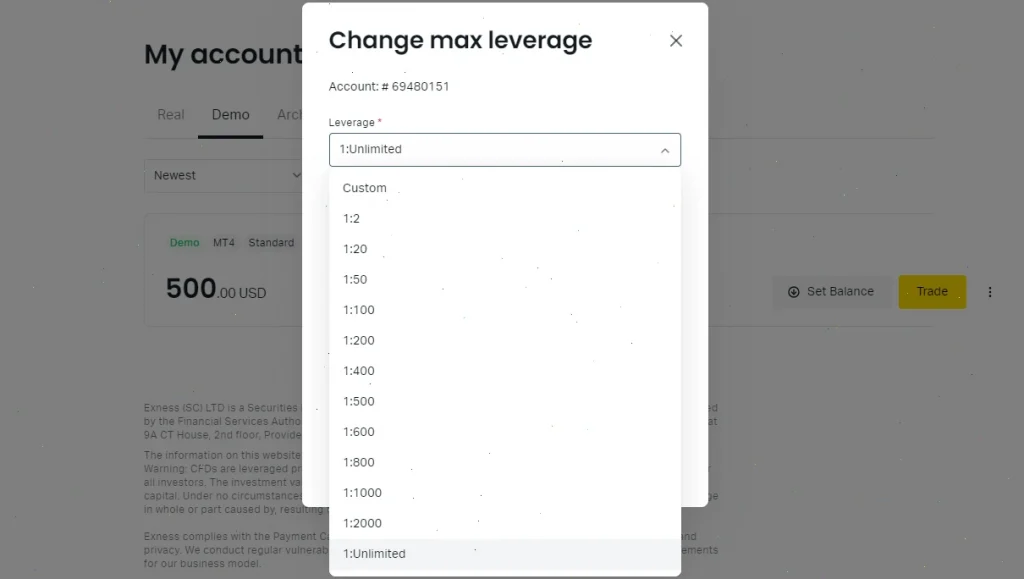
Adjusting leverage on Exness is done through the Personal Area. The process itself is straightforward, but there’s one detail many traders overlook: changes only apply to new trades. Positions that are already open keep the leverage they were created with.
Basic steps
- Log in to your Personal Area
- Open the “My Accounts” section
- Select an account
- Choose a leverage level from the list
- Confirm the update
The system won’t show every possible ratio. What you see depends on your account type, verification level, and internal limits applied to Qatar-based users. In practice, many traders start with moderate leverage (for example 1:100 or 1:200) before testing higher exposure.
Leverage limits by asset class
Not all instruments behave the same, so leverage varies depending on what you trade. Forex pairs usually allow higher ratios, while assets like cryptocurrencies or individual stocks come with tighter limits due to price swings.
- Major forex pairs (EUR/USD, GBP/USD): up to 1:2000
- Minor pairs: typically up to 1:1000
- Exotic currencies: around 1:400
- Gold and silver: up to 1:400
- Oil and energy: closer to 1:200
- Stock indices: 1:200–1:400 range
- Crypto CFDs: usually 1:10 or lower
In practice, this means trading Bitcoin with high leverage isn’t possible in the same way as EUR/USD. The restriction reflects volatility—crypto prices can move several percent within minutes, which increases liquidation risk.
When leverage changes automatically
Before major economic releases (like US inflation data), leverage may temporarily decrease. Traders in Qatar often notice this during high-impact news events. The idea is simple: reduce exposure during unpredictable price gaps.
Margin levels and what they signal
Margin is the part of your balance locked to keep trades open. What matters more is the margin level, which shows how close the account is to risk limits.
| Margin Level | Status | What happens |
|---|---|---|
| Above 100% | Stable | Normal trading |
| 60–100% | Warning zone | New trades may be limited |
| Below 60% | Margin call | Risk of closure increases |
| Below 20% | Stop out | Positions close automatically |
The formula behind it is simple:
Margin Level = (Equity ÷ Used Margin) × 100
From a practical standpoint, traders often watch this number more closely than balance. A sharp move against an open position can push margin level down quickly—especially when high leverage is involved.
Built-in safeguards
Notifications usually arrive before a margin call happens. These can come via the trading platform, email, or mobile alerts. In volatile conditions, the system may also limit leverage to slow down equity drawdown.
Risk management tools inside the platform
Leverage alone doesn’t define risk—it’s how it’s used. Exness includes several tools that help manage exposure without requiring external software.
- Stop-loss and take-profit orders
- Position size calculator
- Negative balance protection
- Custom alerts for margin levels
- Limits on simultaneous positions
The position size calculator is especially useful. By entering a risk percentage (say 1–2% per trade), traders can estimate how large a position fits their account size. This matters more than leverage itself.
Negative balance protection is another detail worth noting. If extreme volatility pushes an account below zero, the balance is reset. This doesn’t remove risk, but it prevents debt after sudden market gaps.
Automated controls
In some cases, the system restricts new trades or reduces exposure automatically. For example, if several correlated positions are open (like multiple USD pairs), additional trades may be limited to avoid concentration risk.
Trading platforms and leverage visibility
Leverage settings are integrated directly into MetaTrader 4 and MetaTrader 5. You don’t need separate tools—the key data is visible in the terminal.
| Feature | MT4 | MT5 | Mobile |
|---|---|---|---|
| Leverage display | Yes | Yes | Yes |
| Margin calculation | Yes | Yes | Yes |
| One-click trading | Yes | Yes | Yes |
| Advanced risk tools | Limited | More detailed | Basic |
| Custom alerts | No | Yes | Yes |
Mobile usage in Qatar
Many traders in Qatar rely heavily on mobile apps rather than desktops. The Exness app mirrors most desktop functions, including leverage adjustments and margin monitoring. Push notifications can be useful when markets move quickly outside local trading hours.
Using leverage more deliberately
More experienced traders tend to treat leverage as a flexible tool rather than a fixed setting. Instead of always using the maximum, they adjust exposure depending on the setup.
- Hedging: opening opposite positions to reduce directional risk
- Partial close: locking in profit while keeping part of the trade
- Scaling in: entering positions gradually
- Trailing stops: protecting gains during trends
For example, scaling into a position allows spreading entry points instead of committing full capital at once. This can reduce timing pressure, though it still requires careful margin monitoring.
Professional account specifics
Professional accounts may offer slightly different margin conditions and execution speeds. However, they usually require verification and some trading experience. The difference is noticeable mainly in tighter spreads and faster order handling rather than leverage alone.
Practical notes for traders in Qatar
For users in Qatar, Exness supports forex and CFD trading with flexible leverage settings and relatively low entry deposits starting from around $10. Payments are typically handled through international methods like bank cards, e-wallets, or crypto transfers rather than local bank systems.
In day-to-day trading, the most important factors aren’t the maximum ratios but how consistently margin is managed. Many traders focus on keeping margin levels comfortably above risk thresholds instead of pushing leverage to its limits.
| Parameter | Details for Qatar users |
|---|---|
| Max leverage | Up to 1:2000 (varies by asset) |
| Minimum deposit | From $10 |
| Margin call | 30%–60% depending on account |
| Assets | Forex, commodities, indices, stocks, crypto |
| Protection | Negative balance protection, alerts |
Leverage can expand opportunities, but it also amplifies losses just as quickly. That balance becomes clear after a few volatile sessions—something most active traders eventually experience.
 FAQ
FAQ
What leverage can I actually use on Exness in Qatar?
The platform allows up to 1:2000 in certain cases, but the available level depends on account size, instrument, and market conditions.
Do leverage changes affect open trades?
No. Adjustments only apply to new positions. Existing trades continue with the original settings.
How does Exness reduce risk during volatility?
Leverage may be lowered automatically, and margin alerts are triggered. In extreme cases, positions are closed if margin levels fall too low.
Why is crypto leverage much lower?
Cryptocurrency prices tend to move faster than forex pairs, so lower leverage helps limit sudden losses.
Can I manage everything from my phone?
Yes, the mobile app supports leverage adjustments, margin tracking, and notifications.